

We asked Claude a simple question. “Show me January, February and March.” It confidently gave us December and January instead.
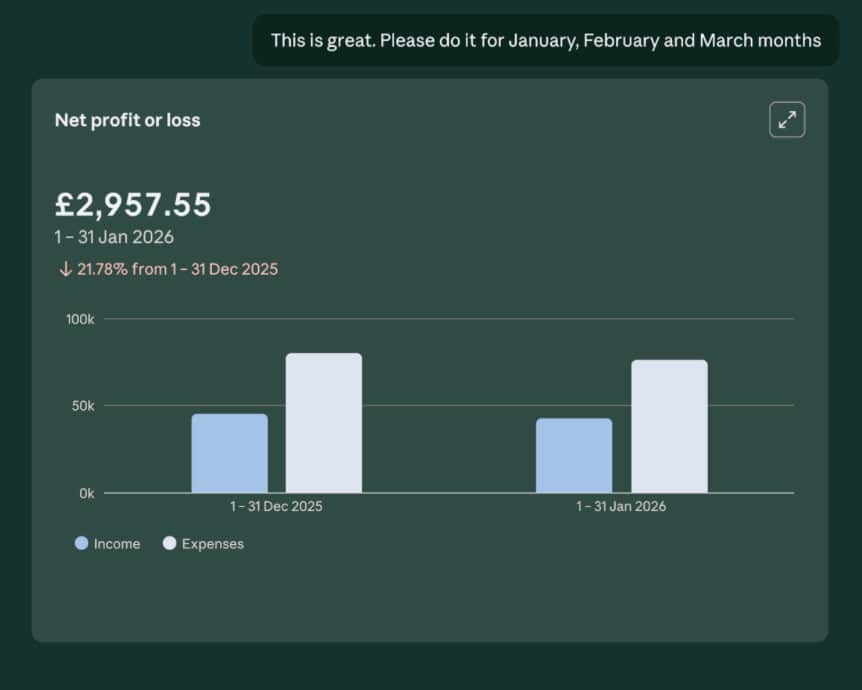
That five-minute experiment perfectly explains why so many AI projects in finance disappoint. And why we think the future belongs to finance teams that understand both the numbers and the systems behind them.
Where AI Falls Short in Finance
This isn’t a one-off. About 9 months ago, when Google released Conversational Analytics and a few other providers shipped similar features, we tried the same thing on our own data back then. The pattern was the same. The system tries to turn a natural-language question into SQL and then point the SQL at a set of tables that were never designed to be queried that way.
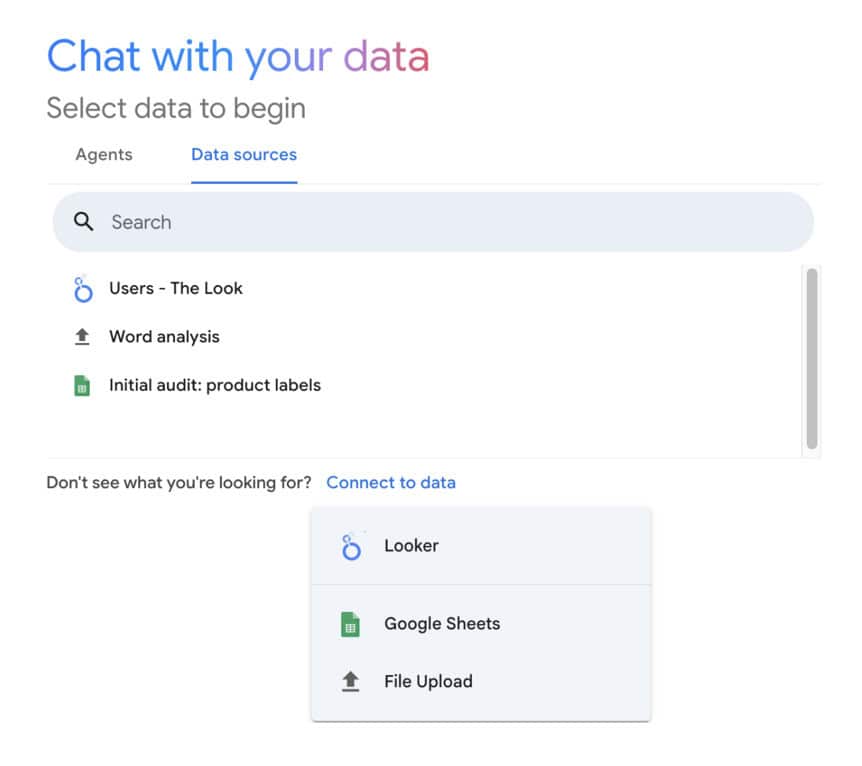
The promise is enormous. The actual experience, though, is one of receiving no sensible answer or confidently wrong answers, again and again.
This is clearly the future: engaging with business data using AI and natural language queries. But a year on, the experience hasn’t improved.
The models have gotten smarter, but the underlying problem hasn’t moved. If the data layer wasn’t built for the question being asked, no amount of model improvement saves you. The hard part isn’t the AI. It’s everything that has to be ready underneath it. Choosing the right model still matters, but it’s only one piece of the puzzle. Different models have different strengths, particularly when it comes to data engineering tasks. See The Best AI Models for Data Engineering in 2025 for a comparison.
“AI Isn’t Ready for Finance”
The wrong lesson to draw from all of this is “AI isn’t ready for finance.” It is.
The models are extraordinary when working with curated data. They reason, they pattern-match, find anomalies, and do recons that would take hours in minutes. We use AI for finance ourselves to crunch years of data and analyse what the right finance team looks like for customers coming on board. It works because everything we feed it is a well-designed, end-user report.
The real opportunity is that accounting and financial analysis have always been a curation discipline, turning the messy real world into a set of consistent, understandable, comparative performance and position data.
And our finance teams, who are working with 100s of businesses, are well placed to solve it effectively at that scale.
AI has just made that more obvious, not less. Plug a powerful analytical tool into raw, unprepared accounting data, and you get a confident wrong answer. Plug it into curated, validated, well-modelled data, and you get something close to a financial superpower.
This isn’t a new insight for us. It’s the same lesson we learned a decade ago with Xero.
Why Xero Still Matters
Our success has always come from curating excellent tools and excellent data, then giving the team room to build with them. Xero is the strongest example of that principle, and it still is. A great tool that lets professionals whip the messy reality of business data into shape. Bank feeds, bills, invoices, journals, all processed and (partially auto) reconciled into a clean set of numbers a business owner can actually use.
That work is what makes everything downstream possible. Once the numbers are in Xero properly, the team can build reporting in a format that makes sense to the business owner. For presentation. For education. For illuminating financial ideas they hadn’t seen clearly before. We’ve been doing that for over ten years, and we’re still doing it every day.
The operating system layer that we’re starting to build now augments that work.
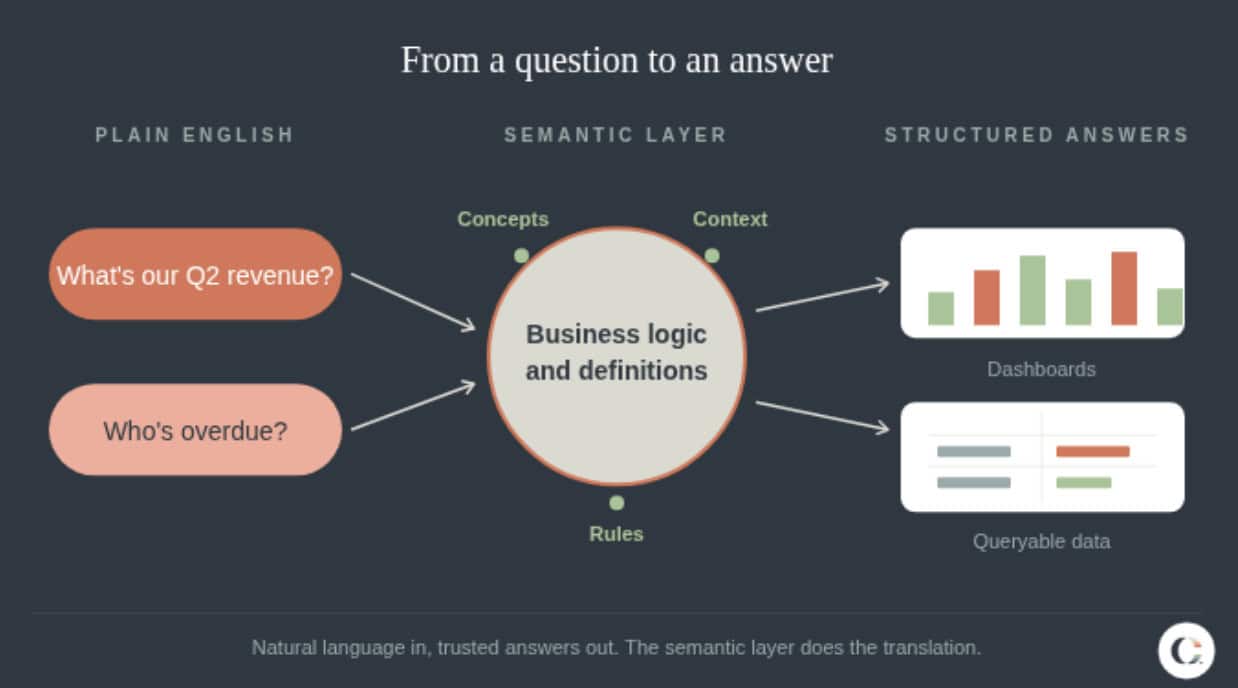
We’ll be pointing AI and a curated semantic layer at the financial data Xero and other key customer systems have already processed, so the analysis gets sharper, and the conversations get richer.
Not a replacement. An augmentation. Same principle, applied to the next layer up. Curate the tools, curate the data, then trust financial professionals to build with them.
The Two Skills Every Finance Professional Will Need
When we sat down to design the next chapter of our operating system, we kept coming back to two pillars.
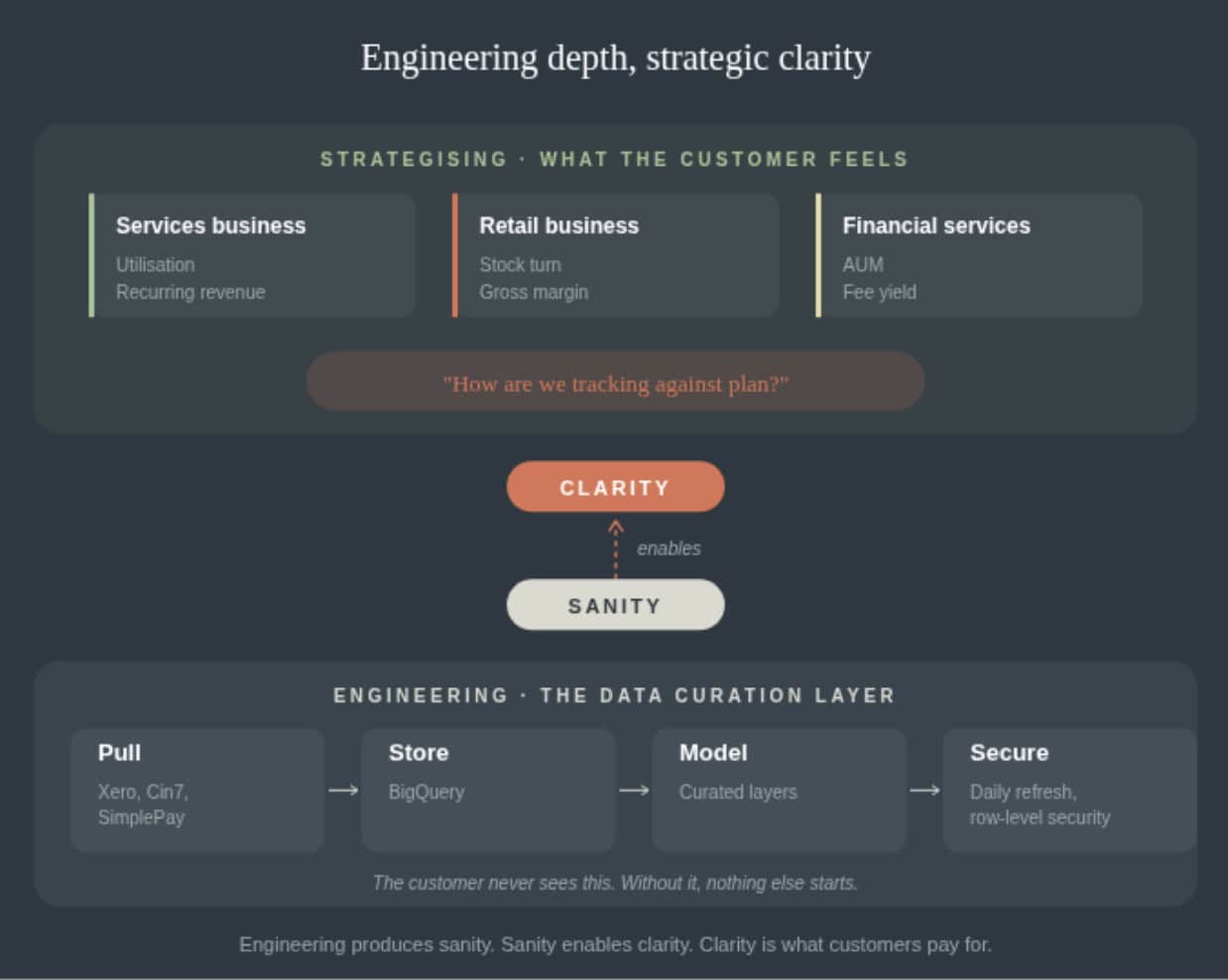
Engineering is the data curation layer. Pulling data out of Xero, Cin7 and SimplePay properly. Storing it in BigQuery. Modelling it through layers into more and more useful tables. Running the daily refresh. Setting up row-level security so the data is secure and permissioned. It’s also why data engineering improves business intelligence and reporting systems far beyond simply making dashboards faster.
Strategising is what the customer actually feels. Understanding what each customer needs from their numbers. Designing the metrics that matter for a services business versus a retail business versus a financial services business. Knowing how a specific founder thinks about cash, and how an owner asks us those questions every day, because that question, in their language, is what turns financial data into a strategic conversation.
Engineering produces financial sanity. Sanity enables financial clarity. Clarity is what customers pay for and stay for.
What’s set Creative CFO apart for a decade is the ability to hold both at once. We engineer professional solutions while being deeply involved in the customer’s business. We implement financials systems, we customise them, we help customers run them. The quality of the systems and their outputs becomes our day-to-day experience, and in many cases, our direct responsibility to run, interpret, and deliver. That’s what allows us to iterate and improve, and stay aligned with the businesses we serve.
So the model we’ve been working to for years is that the best financial professionals wear two hats. With the Engineer hat on, they’re implementing systems, building the data pipelines, the integrations, the AI agents, the production code. With the Strategist hat on, they’re the domain expert, knowing how the customer’s business works, which numbers actually drive a decision, which conversation matters.
The Engineer who can hold a conversation about why a margin moved is more effective than the one who only ships code. The Strategist who can read the data structure underneath the dashboard is more effective than the one who only presents the numbers.
That’s how our teams already operate. A Financial Manager who customises a chart of accounts to fit a customer’s business is wearing the Engineer hat. The same FM walking that customer through what the management report means for next quarter’s hiring is wearing the Strategist hat. When someone writes an AppScript to pull analysis together in one click, that’s the Engineer. When they catch that a customer’s cash worry is actually a margin problem, that’s the Strategist.
About three years ago, we started doing more data-rich reporting work for our customers, and our Business Intelligence team grew out of this work. Pulling the detail out of inventory, point-of-sale, and CRM systems, so that every one of the thousands or millions of items shipped or sold could be analysed properly. That work took us deep into the parts of engineering that are still unsolved in the wider market. Pipelines at scale, semantic modelling, data quality under load, performance. This isn’t the engineering financial professionals are doing day-to-day with their customers. It’s a harder layer underneath that supports it.
That depth is what we’re drawing on now to build the platform. We still believe the best financial team members wear both hats, every day, with their customers. What we’re building is designed to enhance the tools they use, not replace what they do. The engineering work that runs underneath gets done once and gets done well, so every Strategist has more room to compose something useful on top.
No black boxes. If you can’t explain how a KPI was calculated, you don’t put it in front of a customer. That standard applies to AI output just as much as it applies to an existing Xero report.
The Foundation We’re Building
The platform we’re putting together has five building blocks. None of them is a finished product on its own. All of them are what the team composes with.
A curated data layer in BigQuery, refreshed daily. A daily summary engine that posts the headline numbers to Slack or email each morning. A metric layer with our shared definitions for revenue, gross margin, working capital, by industry and then by customer. A Q&A surface that lets a customer or a team member ask a question of the data and get a real answer, grounded in our definitions, showing the working. And a library of n8n nodes for banking, payroll, and accounting connectors, validated, reusable, and version-controlled, so Strategists can compose workflows from them without manually downloading reports.
We’re starting narrow on purpose. Ten customers, two source systems, all professional services, drawn from the kind of business we know best. Tight loops. Visible deliverables every week. Real customer feedback before we scale.
What This Means for Our Customers
For years we’ve been producing month-end reporting at a quality most SMEs would only ever see at year-end. The monthly pack is still the rich narrative on top. That conversation still happens.
What’s changing is what sits underneath. The same standard, brought into daily visibility.
A short Slack or email summary the morning after, showing yesterday’s bank movements, cash position, top transactions, anything flagged. The kind of thing a founder reads while drinking their first coffee. That’s the push. When it makes them curious, they click into the dashboard and see the depth. P&L drilling down to the transactions composing it. Cash position over time. Aged debtors with the names. Payroll cost trending. That’s the pull.
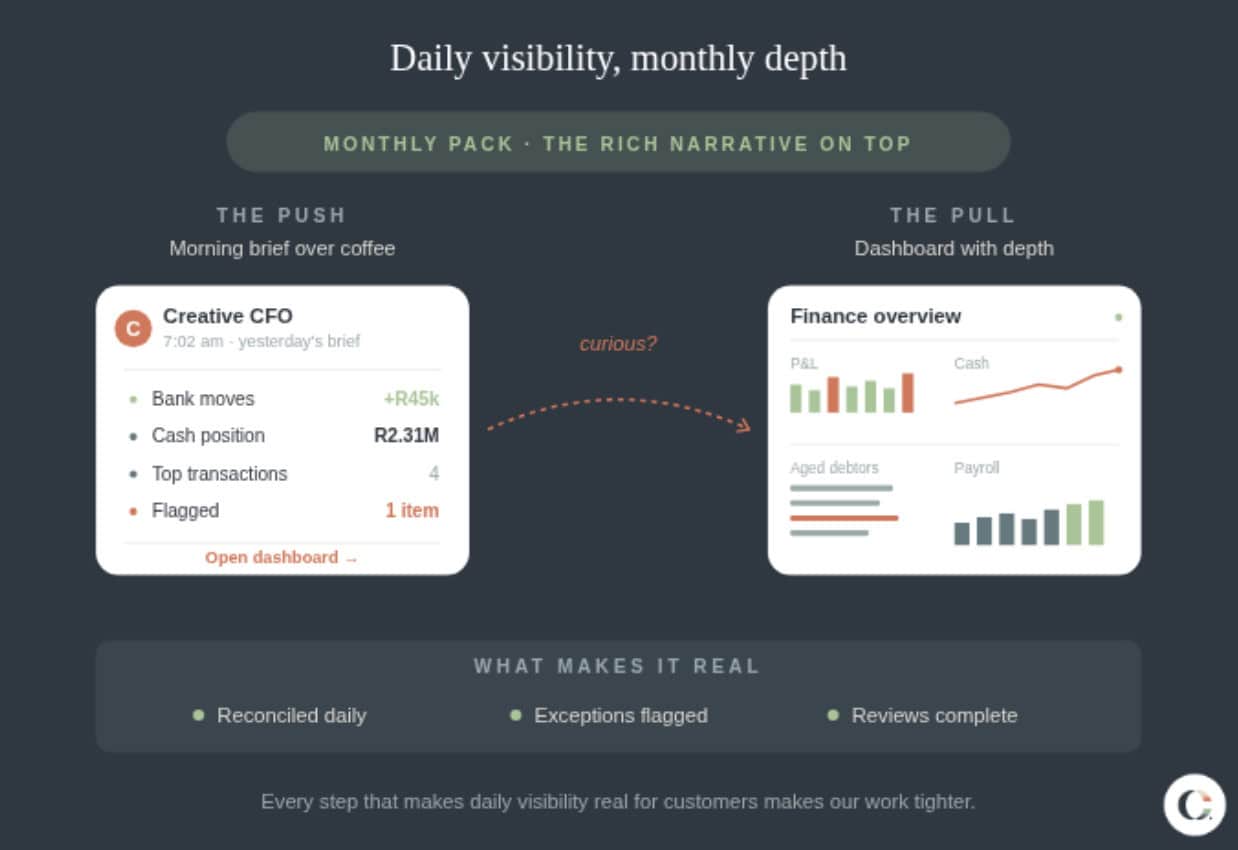
The reason daily visibility is hard, and the reason almost no fractional finance firm in our segment offers it, is that it requires the operational steps under the hood to actually be daily. The reconciliation has to be done. The exceptions have to be flagged. The reviews have to happen. Every step we take to make daily visibility real for customers also makes our own work tighter.
Where Finance Goes From Here
You can’t run a professional services firm on an hourly billing model anymore. Without a system underneath your outputs, one that delivers automation, quality, and risk reduction at the speed of the latest AI models, you won’t be in business in a few years.
The firm that gets this right doesn’t look like a traditional professional service firm. It’s a finance team with the engineering muscle to build and run its own platform. It handles the data engineering quietly underneath. It orchestrates AI on top of that, with the professional controls that keep the answers accurate. It delivers the outputs on a cadence the customer can actually use. And it provides the strategic engagement on top, where the numbers enable the conversations that set the business direction. Each layer earns the next. Each cycle gets sharper with every question asked and answered.
The financial professional doesn’t get replaced. They get sharper tools and a bigger strategic role. The standards go up, not down. Deep understanding of where every number comes from matters more, not less, because AI will confidently give you the wrong month if you let it.
This is the next generation of professional firms we’re building. And it’s the next generation of financial professionals we’re building it with.
If you’re curious to see how AI can improve your financial performance and systems, lets talk.

