

Travel seems like the easy category when claiming back VAT. One invoice, one amount, code it all the travel and you’re set. Well, this is something we often correct because the invoice is usually two or three different things coded under the same thing.
For a business that travels regularly, getting it right makes a real difference to cost.
Flights Are Never One Line
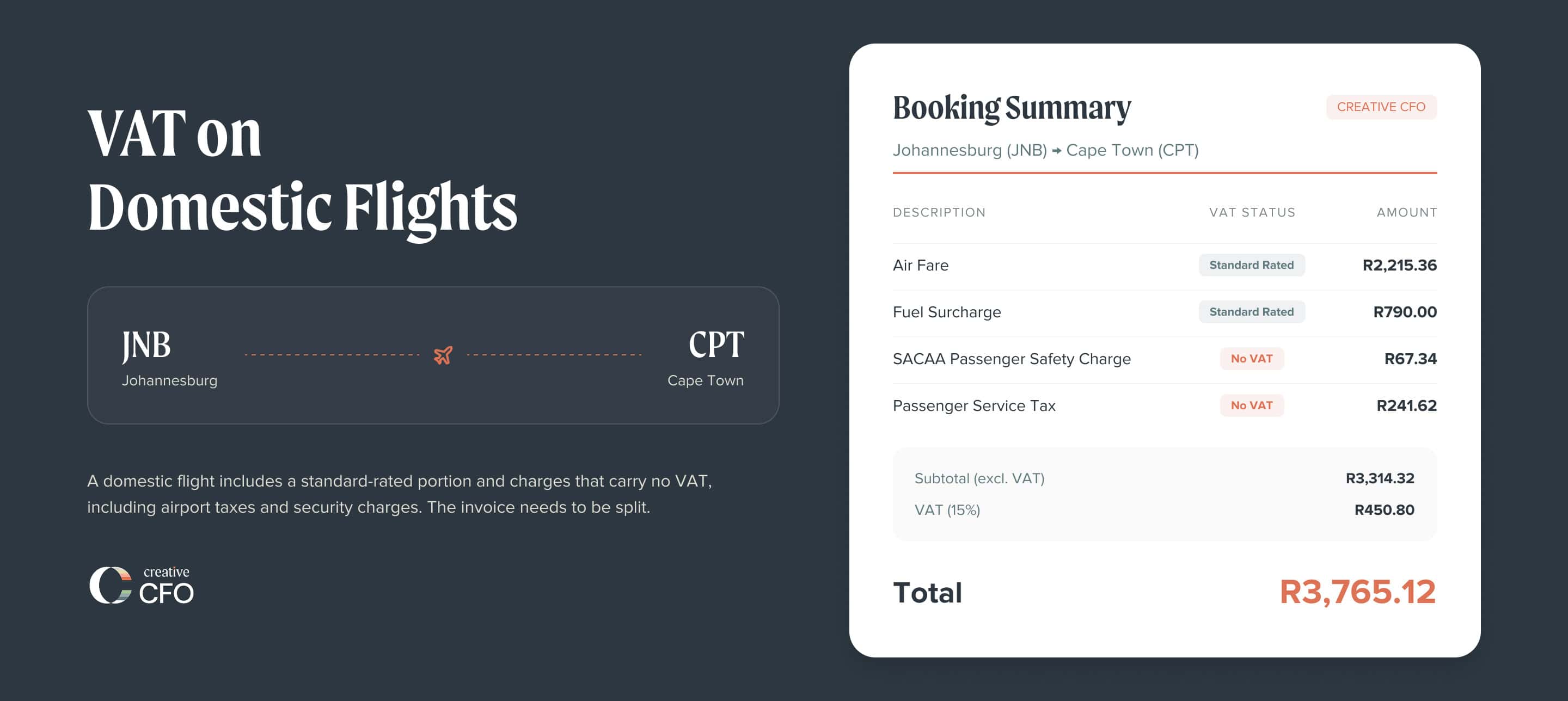
A domestic flight includes a standard-rated portion and charges that carry no VAT, including airport taxes and security charges. The invoice needs to be split.
Take a return ticket from Johannesburg to Cape Town costing R3,765.12:
- Air fare: R2,215.36, standard rated.
- Fuel surcharge: R790.00, standard rated.
- SACAA passenger safety charge: R67.34, no VAT.
- Passenger service tax: R241.62, no VAT.
- VAT: R450.80.
The correct input VAT claim is R450.80. Code the full amount at 15%, and the claim becomes R491.10, which is R40.30 too much. Code everything at No VAT, and the business leaves R450.80 behind.
The understatement costs money, and an overclaim can come back with interest and penalties.
Meals Depend on Where the Person Slept
Entertainment is generally not claimable, including meals. The exception is subsistence.
If an employee is away from home for at least one night on genuine business, the VAT on the meals for that trip can be claimed.
A single overnight trip is enough. The same restaurant slip may be claimable when an employee is travelling, but not when they take a customer to lunch close to home.
The bill does not say which one it was, so put the trip in the description when it is captured, and the traveller needs to say where they were.
Accommodation Follows the Same Test
If the employee is away from home for at least one night on business, the VAT on the hotel can also be claimed.
Keep the flight, hotel and meals under one trip reference. Without it, someone reviewing a December restaurant charge cannot distinguish between subsistence and a year-end lunch.
Car Hire Has More Than One VAT Treatment
If you hire a passenger motor car for a business trip, you generally cannot claim back the VAT on the vehicle rental itself. However, some of the additional fees on the same invoice may have a different VAT treatment.
The fees around the hire are different. Contract fees, delivery or collection charges, additional-driver fees and one-way fees are services. The VAT on those lines can be claimed.
Code the full invoice at 15%, and you claim VAT on the vehicle rental that is denied. Code everything at No VAT, and you lose the VAT on the fees. Fuel is different again: petrol and diesel are zero-rated.
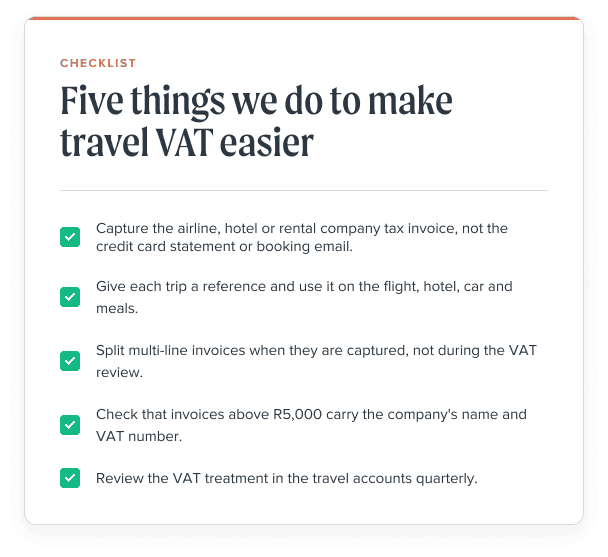
Five Things We Do to Make Travel VAT Easier
- Capture the airline, hotel or rental company tax invoice, not the credit card statement or booking email.
- Give each trip a reference and use it on the flight, hotel, car and meals.
- Split multi-line invoices when they are captured, not during the VAT review.
- Check that invoices above R5,000 carry the company’s name and VAT number.
- Review the VAT treatment in the travel accounts quarterly.
One Simple Rule to Remember
VAT treatment is a per-line decision, not a per-bill one.
Travel is where that shows up most clearly, but it applies elsewhere too, including your bank fees. A rental statement may contain standard-rated electricity alongside levies with no VAT component. Put the whole statement through at one rate, and the VAT is wrong every month.
Multi-line bills are worth the extra minute.
It Pays to Look at the Detail
The bigger lesson isn’t really about travel VAT. It’s about the process.
Good financial management starts with capturing the right information correctly, at the right point. Get the process right, and you spend less time fixing mistakes and more time using your numbers to make better decisions.
If you’re looking for an outsourced finance team with the processes, systems and expertise already in place, Creative CFO can help.

