
Your management report should be the agenda for a decision
Reporting is one part of the finance function we run for you. Every month our team closes the books, produces the report and walks your leadership team through what it means, built in Fathom on a chart of accounts designed around your business.
Let's talk reporting


The Team Behind The Pack


The number is the platform's job. The reason beside it is ours.
Any firm can connect Fathom to Xero. What comes out the other side is only as good as the chart of accounts underneath it and the person writing the commentary on top and interpreting what that means for your business.
That is the part we do, and it is why we would rather be plugged in every month than hand over a setup and wave. A pack is not a compliance exercise you finish and file. It is the agenda for a conversation, and when the reasons are already on the page the meeting skips past what happened and lands on what to do: reprice the line that is carrying you, put real money behind the product that is working, make the hire, buy the business.
Let's talk reportingThe report is the last mile
When a management pack disappoints, the instinct is to go shopping for better reporting software. It is the least effective fix on the table, because a report is only a view of your data. The outputs are only as good as what sits underneath them.
So we start three layers down, with what your business actually does and whether your chart of accounts would tell that to a stranger. Get that right and margin by service line, profit by customer and the reason behind every movement fall out of the accounts on their own. Nobody assembles them at month end. They are simply there, every month, comparable over time.
Fathom is where that work becomes visible. It is a very good last mile, and it is still the last mile.
Let's talk reporting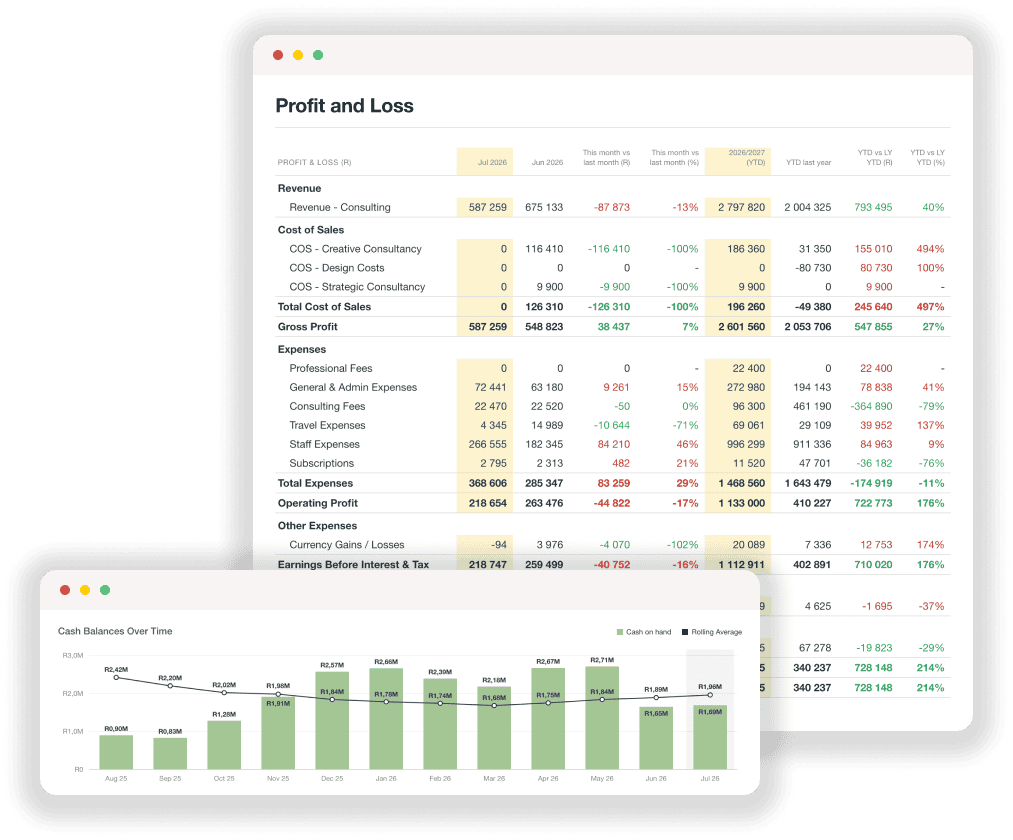
Let’s Talk Numbers
Multi currency consolidation across a group
Consolidation is where our stack earns its keep. We run groups from two companies to twenty, every month. We run groups from two companies to twenty. Multi currency, inter company eliminations, a consolidated pack plus a pack per entity, and one view with every company stacked side by side and the eliminations visible, which is the report accounting teams actually ask for. All of it exports to Excel.

A pack that tells a story
Where we are
What changed, and why
What we do about it
What's in every pack
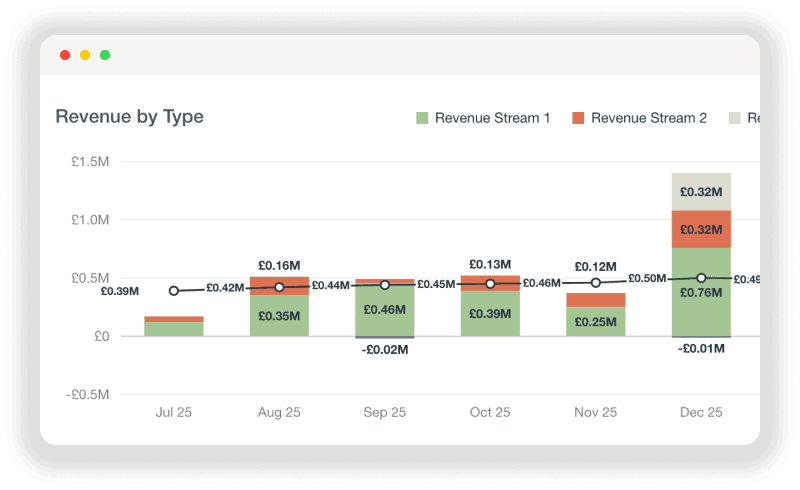
Every number with a reason
Margin by service line
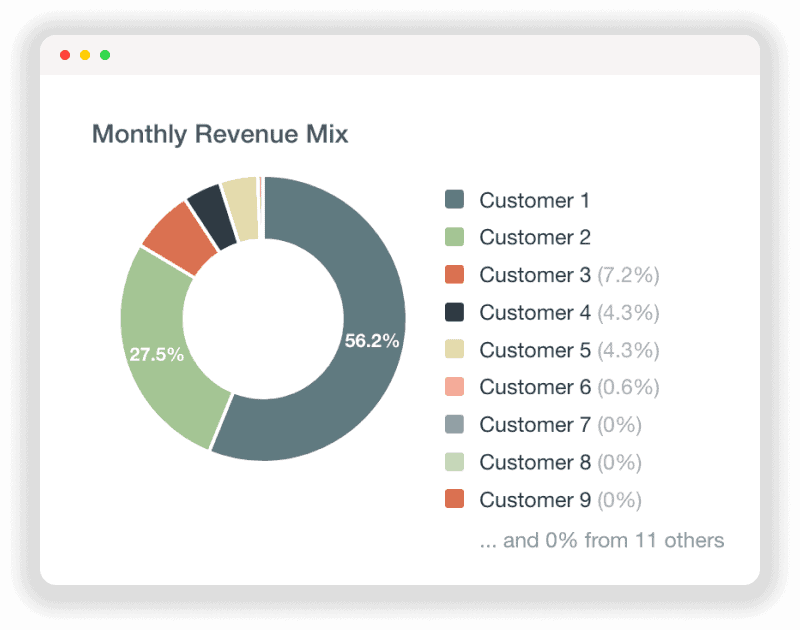
Profit by customer, not revenue by customer
Cash, in the good months too
The KPIs that never touch the ledger
Commentary from the person who did the work
Where Fathom Fits in Our Stack
How it works, month to month
Getting set up
Every month
The conversation
As the business changes
Our Stack
Cin7, SimplePay, Dext
Xero
Fathom
Fathom frequently asked questions
Fathom or Syft?
If you need tracking category reporting across a group, Syft does that and Fathom does not. That is a real reason to choose Syft and we will say so. Where Fathom wins for us is the packaged monthly pack, the commentary, the non financial KPIs, the visuals and multi currency group consolidation. Our team also took to it far faster, which in practice matters more than any feature list.
Fathom or Xero’s built in reports?
Xero is the ledger view, and its reports are good for that. Fathom is where we build the monthly pack, with commentary, KPIs and group consolidation. We use both, for different jobs.
Fathom or Spotlight Reporting?
We ran Spotlight for years before moving to Fathom, and it’s a capable product. The main reasons for moving from Fathom to Spotlight are the ease of report building, insights, customisation, and multicurrency group consolidations.
Can Fathom do forecasting?
It has forecasting, and we are honest about the limits. It is not Excel and it is not Google Sheets. The regression rules and timings are there, but not precise enough for the forecasting metrics we need, so we build forecasts elsewhere and report in Fathom.
How long until my first pack?
Usually four to six weeks from when we start working together for a single company, and eight to twelve for a group. If the accounts underneath need work first, we fix that as part of the close and the pack follows. The variable is always the data, never the software.
Do I need Xero to use Fathom?
No. Sage, QuickBooks and MYOB connect too.
Can Fathom consolidate a group?
Yes, and it is the strongest thing it does. Multi currency, inter company eliminations, a pack per entity alongside the consolidated pack, and an Excel export. Our range is two companies to twenty.
Is Fathom a BI tool?
No. Fathom is management reporting. When a business needs analysis across several systems, that’s the work of our Business Intelligence team, and the two often run side by side.
Can you do the reporting if we already have a finance team?
Yes. For businesses with a CFO or head of finance, we add a second set of eyes and help build out the function. The pack comes with the people who produce it, which is why it’s more than a template.
Reporting is one part of the finance team
Let's build the pack your next decision comes out of
