
Most founders treat provisional tax as a simple administrative hurdle. File it, forget it, move on.
At Creative CFO, we see it differently. February’s deadline is a key moment to minimise your tax burden and maximise cash flow. And here’s how to take advantage of it.
The Bucket Concept
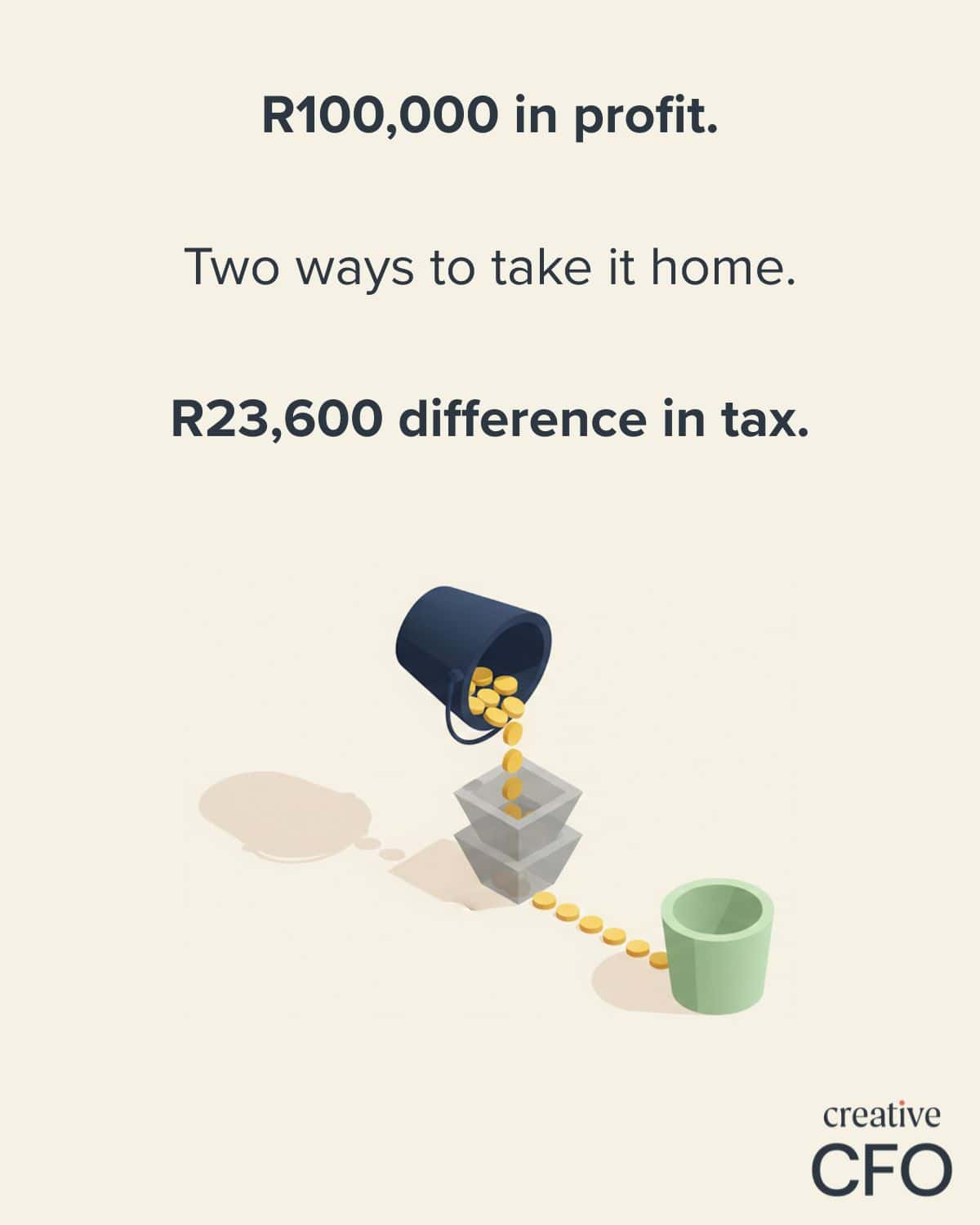
Think of tax rates as buckets. Every rand of profit has to land somewhere: either in your company (27% corporate tax, then 20% dividends tax when you eventually take it out) or in your personal income (taxed at your marginal rate).
The goal is simple: figure out which bucket costs you least for every rand you’re deciding what to do with. We want to optimise the best way to put your next rand in your pocket.
How We Approach This With Clients
Build the foundation first. You can’t optimise what you can’t measure. We start by ensuring 11 months of actual financial data are up to date and reconciled. Without clean numbers, any tax planning is guesswork.
Forecast collaboratively. We build a best estimate for the final month’s performance with the business owner, looking at potential sales, expenses, and strategy changes to estimate the final profit as accurately as possible
Run the bucket analysis. This is where the real value sits. We review the available options, including personal tax brackets, company tax rates, and SBC relief where applicable, and model where each rand of profit should go to reduce the overall tax cost.
Example 1: The Standard Company
A single-director, single-shareholder company has R100,000 of available profit. The director is on an 18% marginal personal tax rate. What are the options?
Option A: Leave it in the company
The company pays 27% corporate tax (R27,000). When the remaining profit is distributed as a dividend, another 20% goes in dividends tax (R14,600).
Option B: Declare it as a bonus
The R100,000 flows directly to the director as a salary bonus, taxed at their 18% personal rate.
| Strategy | Total Tax | In Your Pocket |
| Company + Dividend | R41,600 | R58,400 |
| Bonus | R18,000 | R82,000 |
Result: By choosing the right bucket, you keep R23,600 more of your hard-earned money. 💡
Example 2: The SBC Split
A Small Business Corporation has R650,000 profit. The director earns R720,000 per annum and sits in the 39% personal tax bracket.
The problem: SBC rates are fantastic at the lower end (starting at 0%), but once profit exceeds R550,000, the rate jumps to the standard 27%. After adding dividends tax, the effective rate on that top slice becomes 41.6%, higher than the director’s available 39% personal rate.
The fix: Split the profit between the two cheapest buckets.
Step 1: Fill the SBC bucket (first R550,000)
Leave R550,000 in the company to utilise the tiered SBC rates (0%, 7%, and 21%). The company tax comes to R57,698. When eventually distributed as dividends, another R98,460 in dividends tax applies, but the effective rate on this portion is still only 28.4%.
Step 2: Fill the personal bucket (remaining R100,000)
Instead of letting the remaining R100,000 get hit by the company’s 27% rate plus dividends tax (41.6% effective), declare it as a bonus taxed at the director’s 39% marginal rate.
| Strategy | Total Tax | In Your Pocket |
| Optimised Split | R195,158 | R454,842 |
| All Dividend | R197,758 | R452,242 |
| All Bonus | R263,742 | R386,258 |
Result: The optimised split saves R68,584 versus all-bonus, and R2,600 versus all-dividend. The difference comes from asking a simple question for each portion of profit: which bucket is cheapest right now?
The Takeaway
Optimisation isn’t all-or-nothing. It’s about finding the right mix. Before you file, ask yourself: which bucket should my next rand go into to maximise the cash in my pocket?
A Few Important Notes
Cash-flow timing differs between routes. When your personal rate is above 27%, it might be cheapest overall to put a rand in your pocket via a bonus, but remember you pay that tax upfront. With the company route, you pay provisional tax now and dividends tax only when you eventually declare the dividend. Cash flow matters.
High earners have different maths. If you’re already in the top 45% income tax bracket, company tax plus dividends (effective ~42%) offers a lower rate than the personal bonus route.
Retirement annuities change the equation. RA contributions reduce your taxable income, which can shift where the breakpoints fall. Factor these in before deciding.
Bonuses need commercial substance. SARS expects bonus payments to be justified by the work performed. Keep this in mind when structuring.
There’s a small payroll cost. The bonus route attracts UIF and SDL contributions, roughly 1% effective. The tax saving typically dwarfs this, but it’s worth noting
When in doubt, get advice. If any of this is unclear for your specific situation, chat to a professional before filing.
The AI prompt that runs the calculation
This is a structured prompt for Company vs SBC vs personal tax optimisation in South Africa, for the year ending Feb 2026.
Copy the full prompt into Claude, it’s been tested with Opus 4.5
*Disclaimer: Whilst every time we’ve run this we’ve got the right core tax calculations, there are often elements of the answer that need to be checked and tweaked (e.g. the order of the optimisation in a table might have been displayed incorrectly). We have tweaked the prompt several times to improve quality, if you don’t understand any part of the calculation, check with a professional!
To run the analysis, you need three things:
- Total company profit to distribute: the amount available for this bonus/dividend decision
- Your current taxable income: from other sources (salary, other income) before this distribution
- Does the company qualify as an SBC?: remembering the key requirements: all shareholders are natural persons, gross income ≤ R20m, no shareholders hold shares in other private companies, not >20% from investment income/personal services, not a personal service provider

