
Every finance professional I know has a list.
Not the to-do list. The other one. The “I’d fix this if I ever had time” list. The automation that would save hours every month. The process that’s held together with copy-paste and good intentions. The customer dashboard technically works, but doesn’t surface the real insight. The month-end review that gets done but is never questioned.
That list never gets touched because the pressures of the day-to-day never stop. And that’s the fundamental challenge of deep work for finance teams.
At Creative CFO, we build and run finance and business intelligence teams for 75+ companies across South Africa, the UK, the Netherlands, and Dubai. Our team of 40+ manages everything from bookkeeping to board packs, from management reporting to IFRS financials, from audit prep to real-time dashboards. We’re not short on work. What we were short on was headspace.
And here’s the thing. When your finance and BI teams don’t have headspace, your customers feel it. Not immediately, and not always obviously. But it pops up. In the dashboard, the data is displayed, but the insight isn’t. In the management reports that arrive on time but lack depth.
We weren’t delivering bad work. We were leaving better work on the table.
As Shane Parish says, people need to spend more time thinking, even thinking about thinking, is valuable. He emphasises that to do better, you have to take the time to think better first. Take a moment, stop and actually think.
Why Deep Work for Finance Teams Requires Collective Protection
The standard advice is to block time for deep focus. Put it in your calendar and protect it. Be disciplined. For the extremely successful businessman Warren Buffett, he highlights that a lot of his success came from the idea of pausing and thinking more, rather than constant activity.
But anyone in a customer-facing finance role who’s actually tried to stop and think knows how this goes. A query comes in. Month-end lands early. Someone needs something urgently. This protected time disappears because delivery always comes first.
But here’s what nobody talks about: the issue isn’t discipline. It’s that you can’t create flow state while your colleague is still fielding calls and pinging you with questions.
Individual time-blocking doesn’t win because someone else’s urgency always becomes your interruption.
We needed something different. Not a personal productivity hack – a team commitment. Something that gave everyone permission to go deep at the same time, so nobody felt guilty for being unavailable, and nobody’s focus got interrupted by someone else’s delivery pressure.
The insight was simple: individual flow requires collective protection.
What Flow Fridays Actually Is
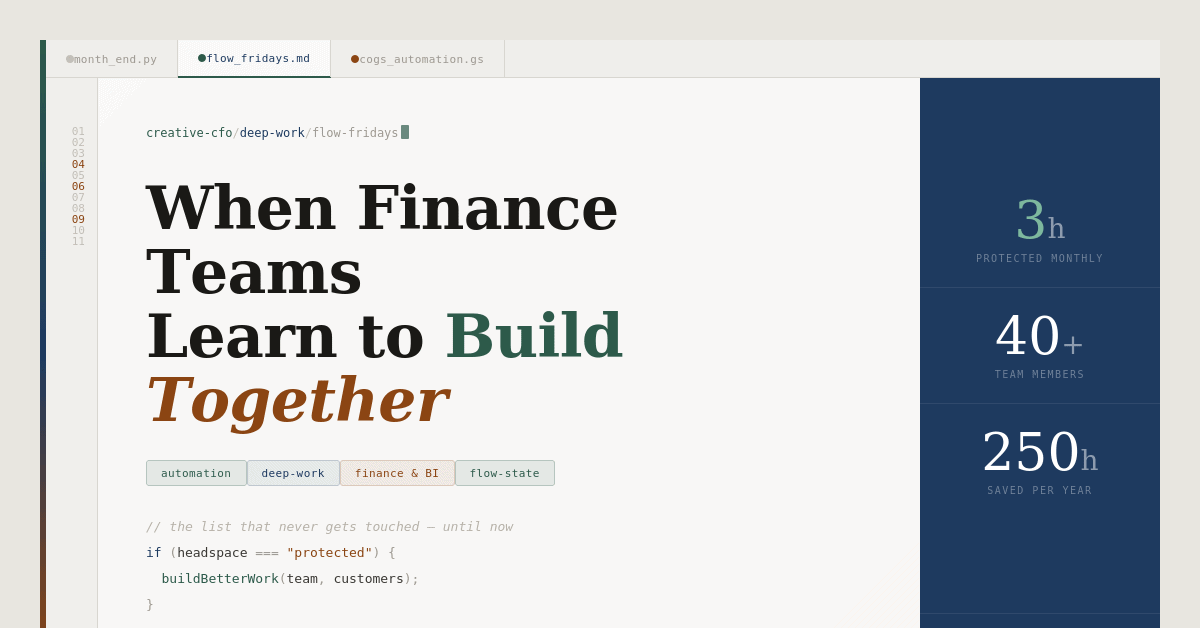
On the third Friday of every month, we block 3 hours across the entire company. 9am to 12:30pm. No customer calls unless emergencies. No meetings. No Slack pings. No email. Just deep, focused work on the business – not in it.
Blair Enns coined the term innoficiency, which means that the work that actually moves a business forward, solving messy problems, rethinking systems, and improving decision-making, is rarely efficient. It requires time, space, and a willingness to step away from constant activity and output.
The power is in the collective commitment. When everyone’s unavailable at the same time, no one feels like they’re letting the team down. No one’s breaking anyone else’s concentration. The usual guilt that kills solo deep-work attempts simply doesn’t exist.
The structure is deliberately simple. A 15-minute kick-off to create headspace and set intention, then heads down for 3 hours, and a 15-minute check-out where each person posts three things in Slack: what friction they identified, how they’re fixing it, and where they got to.
We call it “Friction, Fix, Progress.” We didn’t ask people to dream up huge ideas. We asked them one question: what slows you down? Low barrier, high relevance. And because our team is closest to customer work, the friction they identify is almost always customer-facing.
The name reflects the intent. Flow Fridays isn’t a catchy brand exercise. It’s honest. The whole point is to create the conditions for deep work for finance teams—that deep, uninterrupted focus where the best thinking happens. The state that’s almost impossible to reach when you’re bouncing between email, Slack, and customer queries.
What Happened When 33 People Went Deep Together
Our first Flow Friday was 30 January 2026. Thirty-three team members participated. Here’s what matters: almost every project they chose was about removing friction from customer work. Not internal admin. Customer delivery.
- The invoice capture automation. One team member tackled something that affects every finance team: invoice capture. Customers send invoices by email. Someone has to forward them to Dext. Every. Single. Time. She used Gemini and Apps Script to build a workflow that fetches emails containing invoices not in Xero, logs the details to a Google Sheet for review, and pushes them into Xero as draft bills. When it goes live, her customers get faster invoice processing, fewer missed bills, and a cleaner creditors’ age analysis at month-end.
- The transcript organiser. One BI team member built an automated transcript organiser for a customer who had 768 meeting recordings dumped in a single Google Drive folder since 2022. Nobody could find anything. Using Apps Script and n8n, he automatically categorised over 800 files. The next step is extracting insights with AI – turning years of accumulated conversations into searchable, actionable knowledge.
- The COGS automation. One of our finance team members was spending hours every month on manual COGS calculations for an e-commerce customer. Pulling data from Takealot, running scenarios, and cross-referencing the data warehouse. Every month, the same process. Every month, the same risk of human error. In 3 hours, she built a Google Apps Script framework that categorises transaction rows, applies the right formulas per category, and automatically compares outputs against the data warehouse. That customer now gets faster, more accurate cost reporting with fewer manual touchpoints. The time she reclaimed? That’s time spent analysing margins and flagging opportunities.
- The payroll workflow. Another team member was running payroll for a UK customer, where each pay run required manual updates to bank payment templates. Supplier details, currency checks, debit order exclusions. One wrong entry and a payment fails or goes to the wrong account. He built a Google Sheets workflow where you paste the Xero pay run export, and the formulas handle the rest: matching supplier banking details, excluding debit orders, and flagging non-GBP payments that need separate processing. The customer probably won’t notice the difference. That’s the point. What they will notice is that nothing falls through the cracks.
- The data quality fix. On our BI team, a Data Engineer found that bugs had been quietly accumulating across multiple tabs in a customer’s data portal. Nobody had flagged it because the dashboards still loaded. They just weren’t entirely right. She tested and fixed everyone, then added a data quality layer that didn’t exist before. That customer’s leadership team is now making decisions on cleaner data. They’ll never know how close they were to not having it.
- The reconciliation rebuild. One of our BI engineers rebuilt the foundation of a customer’s reconciliation reporting. The existing report had been running on outdated API tables, and the data quality issues were starting to compound. He built three new core API tables from scratch, resolved the underlying issues, and is now finalising the reconciliation logic. That customer’s finance team will soon be reconciling against data they can actually trust.
- The AI-powered monthly review. One team member who manually manages monthly reporting reviewed Xero trial balances and Fathom reports for each of her customers each month. Pulling the data, checking for anomalies, and comparing to prior periods. She built an automated review trigger in n8n that refreshes Xero data via G-Accon, sends her a Slack reminder when it’s ready, and runs a master prompt in Claude to flag variances and exceptions. The monthly review that used to take an afternoon of clicking through tabs now starts with an AI-generated exception report on her desk. She spends her time investigating exceptions, not finding them.
- The revenue dashboard unblock. One of our Business Accountants discovered that a customer’s revenue dashboard had been blocked because we didn’t have direct access to their inventory system’s API. Instead of waiting, she built a custom report extraction in Google Sheets that pulls the necessary data, with a plan to connect it directly to Metabase. That customer was weeks away from having a live revenue dashboard instead of months—because someone had 3 hours to find a workaround and build it.
The Maths That Matters
Here’s the compounding effect in numbers.
One 10-minute save, repeated 50 times a year, across 30 people: 250 hours. That’s 31 full working days reclaimed annually.
Thirty friction fixes per month, across 12 months: 360 improvements annually.
Get just a handful of those right every year, and a conservative estimate of cumulative capacity created: 1,000’s hours redirected to advisory work.

But saved time only matters if you redirect it somewhere valuable. That’s the real point of deep work for finance teams.
Every hour our finance team spends on a manual reconciliation is an hour they’re not spending on variance analysis. Every afternoon lost to formatting a report is an afternoon they’re not helping a customer understand their cash flow forecast. Every hour our BI team spends fixing a broken pipeline is an hour they’re not building the dashboard that helps a CEO spot a margin problem before it becomes a cash problem.
The businesses we serve don’t need us to just close their books and build their dashboards. They need us to tell them what the numbers mean. Where the cash pressure is building. Which product line is quietly bleeding margin. Whether their cost structure can survive the growth they’re planning.
That’s the work that changes outcomes, and it only happens when the operational layer underneath it is tight enough to free up capacity for it.
Why Finance Teams Need to Lead Deep Work Together Lead This Together
The accounting, finance, and business intelligence profession is going through the most significant shift in decades. AI can draft financial commentary; reconciliation engines are getting smarter every quarter, and the tools available to a 5-person startup today would’ve required an enterprise licence and a dedicated IT team five years ago.
Our customers are adopting these tools. They’re automating their sales pipelines, their marketing, their customer support. And then they look at their finance function and ask: why does this still feel manual?
That’s a fair question. And if we’re going to be the people who help them answer it, we need to be doing it ourselves first. We can’t credibly advise a customer on automation if our own processes are held together with copy-paste.
This is why one of our OKRs this year is for every team member to be able to code. Yes, finance professionals are learning to code. SQL, JavaScript, Python, or Ruby. Not to become software engineers, but because the line between financial operations and technology has disappeared. The team members who built those automations didn’t wait for IT to build them for them. They identified the problem and wrote the solution.
Flow Fridays is where experimentation becomes collective. The Apps Script automation built for one customer’s COGS becomes a template for another. The data quality framework added to one portal becomes standard practice across all of them. The invoice capture workflow, tested on one demo company, gets refined and deployed for five more.
Our customers benefit from the collective R&D of the entire team – not just the person assigned to their account.
What Made It Work
The collective commitment is everything. Individual time-blocking fails because someone else’s urgency becomes your interruption. When everyone goes deep at the same time, nobody feels guilty for being unavailable, and nobody breaks anyone else’s focus. You’re not protecting time alone. You’re protecting it together.
The “Friction, Fix, Progress” framework kept things grounded. We didn’t ask for moonshots. We asked: What slows you down? Low barrier, high relevance.
The check-out creates accountability and cross-pollination. Posting updates in Slack meant one person’s automation sparked a conversation with someone on a completely different team who had the same problem with a different customer. A BI solution inspired a finance workflow. Solutions started spreading laterally, which is exactly what you want in a firm managing 75+ customer accounts across multiple geographies.
Small wins compound, especially when the whole team is winning. Three hours a month. Thirty-three people. Every improvement we make internally flows directly into the quality of work our customers receive.
A Few Things to Note
This isn’t about working less. It’s about creating protected time for the work that usually gets crowded out by delivery pressure. The operational work still gets done – Flow Fridays creates capacity for the strategic layer on top.
Not every project will ship immediately. Some automations need testing, refinement, and approval before they go live. The invoice capture workflow is still in demo. The transcript organiser is responsible for the next phase. That’s fine. Progress over perfection.
The benefits compound over time. One Flow Friday won’t transform your business. Twelve might. The point is systematic, sustained investment in getting better, together.
Ryan Schmitz is COO at Creative CFO. We build and run fractional finance and business intelligence teams for high-growth businesses across South Africa, the UK, the Netherlands, and Dubai. If you’re thinking about how to create space for deep work in your finance team, reach out.

